FOR IMMEDIATE RELEASE
Stephen Westfall: Better Angels
November 7, 2026 – December 19, 2027
Opening reception: Saturday, November 7, 2026, 3–6 pm
Public conversation with David Pagel: Saturday, November 7, 2026, 1 pm
Serious Topics is delighted to present Stephen Westfall: Better Angels. Westfall takes the title of his show from the close of Lincoln’s First Inaugural, the last appeal to the South before the war, when Lincoln insisted “we are not enemies, but friends.” The show, nine new paintings and a wall painting, opens November 7th, four days after the midterms, and it’s hard not to read the paintings as a kind of spell, an attempt to hold something together that is pulling apart.
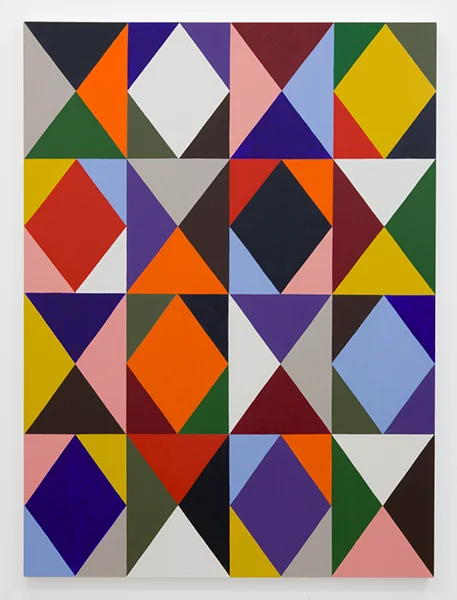
Structurally, the paintings recall R.D. Laing’s Knots, the 1970 book in which each short piece loops back on itself, one person’s view of another’s view nested layer upon layer, until a relationship becomes a pattern you can almost diagram. Westfall’s paintings in Better Angels work the same way. Each canvas sets up a grid, and within each cell triangles meet at their tips, every shape depending on its neighbor to complete it. A diagonal that closes one cell opens the next, and a color that is figure in one place becomes ground a few inches away. In the painting Better Angels, from which the show takes its name, diamonds alternate with hourglass crossings so the eye moves between forms that are held and forms that are pinched at the center. In The Sirens, triangles point up, down, left and right, each turned toward or away from the others, like voices at cross purposes, yet the whole stays in balance. Night Dreamer and Point Break reduce this to four quadrants converging on a single point, , the web of dependencies pared down to one shared meeting place. Carapace folds it inward, a yellow diamond held inside a larger diamond split between red and deep blue.
The wall painting, entitled River, lets the interlocking pattern run loose. Tall triangles alternate point up and point down along the left like a row of rapids. A narrow plum column of stacked chevrons turns the movement sideways, and on the right, broad bands of red, orange and pink tilt across the wall around a central column of slanted stripes, like water moving past a piling. Where the canvases hold their tension in place, River flows.
The feeling is calm but insistent, almost frantic, but in a way that moves forward: syncopated, symmetrical, and set on an apparent grid. Westfall talks about his relationship to California painting, but when I see his red, yellow and blue, I think of New York City. When he paints green, brown and pink, it’s another story. The light is different in California, and the tertiaries capture it.
These paintings are like the children’s game “step on a crack, break your mother’s back.” I took it to an extreme balancing game. If I stepped on a crack with my right foot, I had to step on one with my left to cancel it out. Then I had to step with the left first and then the right, to balance out the first time. Then four times in reverse, a physical palindrome, all in service of preserving my mother’s back. I would keep going back and forth, many times, until something else interrupted me. Westfall’s paintings have that same quality of balancing and counterbalancing, each move answered by its mirror, as if enough symmetry, carefully kept, could ward off the break.
— K. Calabrese
Stephen Westfall (b. 1953) received his MFA in 1978 from the University of California, Santa Barbara. His first solo exhibition in 1984 at Tracey Garet in New York’s East Village earned reviews that took note of his particular brand of geometric abstraction. Exhibitions followed during the 1980s and into the 1990s at Daniel Newburg Gallery in New York, Galerie Paal in Munich, and Galerie Wilma Lock in St. Gallen, Switzerland. An exhibition of paintings took place at Andre Emmerich Gallery in New York in 1995, followed by several exhibitions at Lennon, Weinberg, Inc., and Galerie Zurcher in Paris. Recent work has been exhibited at Kunstgalerie Bonn in Germany, David Richard Gallery in Santa Fe and Alexandre Gallery in New York. He taught as a professor at the Mason Gross School of the Arts at Rutgers University for twenty years. Stephen Westfall is represented by Alexandre Gallery.